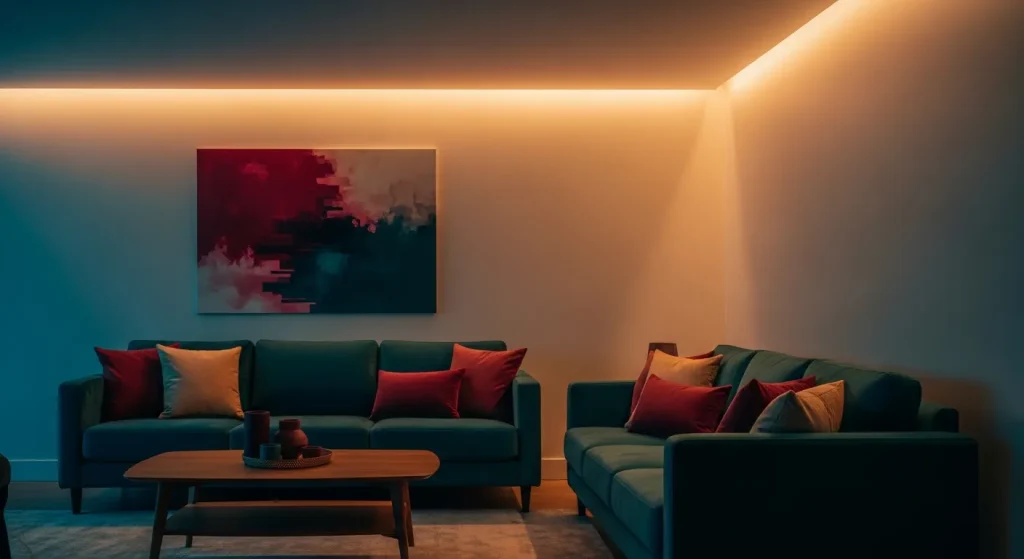
You walk into the living room, one tap on your phone, and the light dims to a warm, golden shade. The kitchen turns on by itself when you walk in with bags, and the yard lights up as soon as someone approaches the gate. Smart home lighting is not a luxury for catalogs, it is a small thing that changes how you feel in your rooms every evening, and it saves you money in the process.
In this guide, we go through what really works: how to build atmosphere with light, where the savings are hidden, and how to start smartly, room by room, without renovations and without a handyman.
Atmosphere Starts with Light Temperature
The biggest difference is not how bright the light is, but what color it is. Warm light (around 2700K) relaxes, calms, and makes the space inviting, perfect for the living room and bedroom in the evening. Cooler, white light wakes you up and helps you focus, so it works great in the kitchen and in a work corner.
Smart bulbs give you both worlds in one bulb: you start the morning with a fresh white shade, and in the evening you switch the same lamp to a warm, candle-like glow. No need to buy new fixtures for every mood, only the light changes, not the bulb.
Tip: do not light a room with a single strong ceiling source. Combine a ceiling fixture for general light with one or two decorative lamps in the corners. Three levels of light at different heights give the space depth and that softness that makes a room look more expensive than it is.
Where the Savings Are Hidden
LED lighting is the standard today for a reason, it uses up to several times less power than old bulbs and lasts for years. But the real savings with smart lighting come from one habit that the machine takes over for you: the light is on only when needed.
- Motion sensors in the hallway, pantry, and bathroom turn the light on when you enter and off when you leave. No more bulbs burning all night because someone forgot the switch.
- Timers and schedules turn on the kitchen in the morning before you get up, and in the evening they gradually dim everything, less consumption, a more natural daily rhythm.
- Dimming is not just for atmosphere: light at 60% strength uses less power, and the eye barely notices the difference.
- Solar lighting for the yard, garden, and driveway works completely free, it charges during the day and lights up at night, without a single cable pulled.
All this means your electricity bill drops not because you are in the dark, but because the light stops working when no one needs it.
Room by Room: What Goes Where
The easiest way is to start with one room and expand. Here is how to arrange light where it matters most.
Kitchen. Here, light has to work. White, clear lighting above the countertop and stove makes cutting and cooking safer, and a warm strip under the upper cabinets adds warmth in the evening. A smart ceiling fixture that changes temperature covers both scenarios at once.
Living room. The heart of the atmosphere. One warm decorative lamp next to the couch completely changes the evening. Add dimming and you have both reading light and movie light in the same place.
Bedroom. The warmest shades, the softest light. A lamp on the nightstand that turns off by timer or voice means you do not have to get up when sleep catches you.
Hallway, entrance, and yard. The kingdom of sensors. Light that turns on with motion saves both nerves and electricity, and outside it adds a layer of security, a lit driveway is less inviting to uninvited guests.
Light and Order Go Together
A well-lit space also needs an organized space, one does not breathe without the other. When you light shelves and work surfaces directly, you immediately see how many little things are out of place. That is why smart light and storage and organization solutions work as a pair: a lit, tidy shelf looks like a display, and a cluttered one looks like a warehouse, no matter how nice the lamp above it is.
A small trick: stick an LED strip inside a closet or a dish shelf. Open the door, the light turns on, and suddenly everything has its place and its shine. That is the detail that makes a home feel thoughtful, not accidental.
How to Start, Without Renovations
The beauty of smart lighting is that it does not require renovation. The simplest start:
- Replace the bulbs in the two rooms you use most with smart bulbs, you immediately get dimming and color change.
- Add one decorative lamp where you spend the most time in the evening.
- Put a motion sensor in the hallway or pantry and let it do the job of forgetting the switch for you.
- For the yard, get a solar floodlight, no cables, no bills, and it installs in a few minutes.
From that small base, the system grows naturally. Next month you add an “evening” scene, then a morning schedule, then connection to the rest of the smart home. There is no big leap, just a series of small, pleasant upgrades.
Conclusion
Smart home lighting does two things at the same time, and we usually think we have to choose: it creates the warmth and ambience that make you love being at home, and it also cuts consumption because the light is on only when needed. A warm evening and a lower bill are not opposites, they are the same decision.
In our lighting range, you will find smart bulbs, decorative and LED lamps, ceiling fixtures, and solar floodlights, as well as everything for the smart home, home, and organization that completes this system. Choose the room you start with, the rest comes on its own.
[SHOP-CTA]