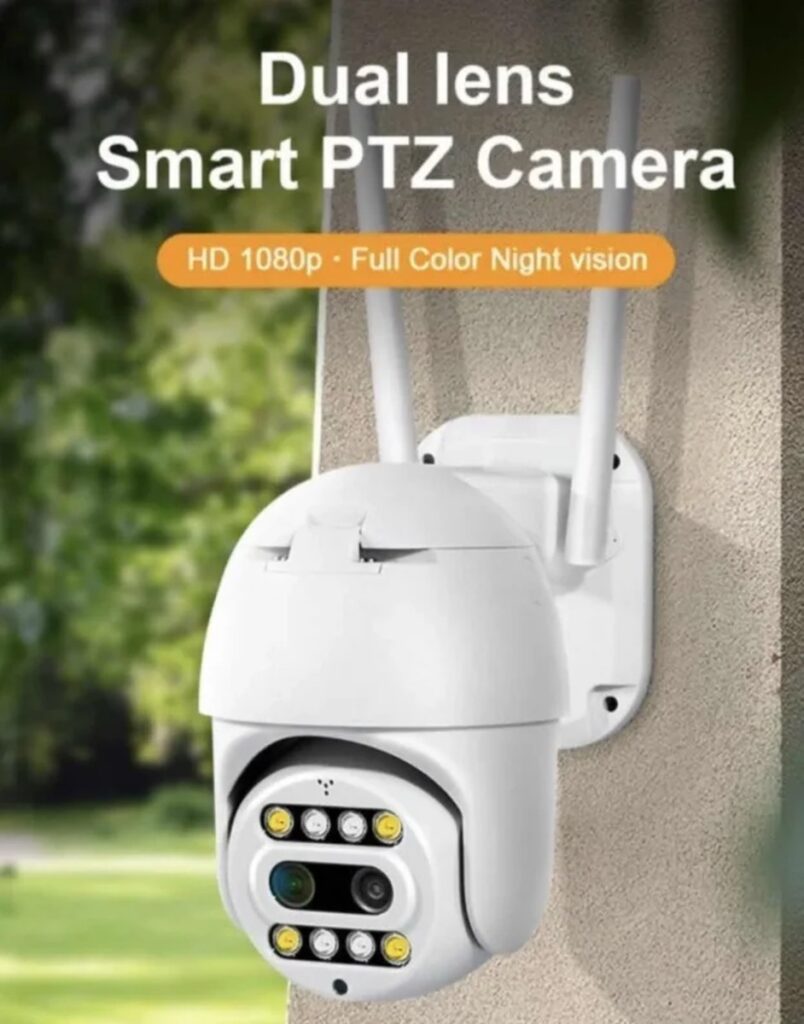
Key points in brief:
- 4K resolution is not always necessary; for most yards, 2K or even Full HD is sufficient.
- PTZ (pan-tilt-zoom) allows remote camera rotation, but it is not a substitute for a wide-angle fixed camera.
- Night vision depends on IR range and the number of LED diodes; check the actual range, not the declared value.
- Power supply (PoE, 12V, battery) significantly affects reliability and installation costs.
- Do not chase the most expensive model; focus on what your yard actually requires.
When choosing a WiFi camera for the yard, it is easy to fall for marketing tricks: 4K, PTZ, night vision up to 50 meters… But what does that actually mean in practice? This guide helps you understand the key specifications and choose a camera that fits your needs without overpaying.
Whether you are protecting a house, garage, or weekend cottage, it is important to know where the line is between useful features and sales talk. We will break everything down into plain language, with practical examples.
Resolution: 4K is not always a smart choice
Resolution determines how much detail the camera captures. 4K (3840×2160) provides extremely sharp images, but requires more storage space and a stronger WiFi signal. If you only need to see who enters the yard, Full HD (1920×1080) is often quite sufficient.
- Full HD (2MP) – enough for face recognition at distances up to 5-7 meters.
- 2K (4MP) – better balance between detail and requirements; recommended for most households.
- 4K (8MP) – useful only if you have a large yard and want to zoom into fine details later.
Keep in mind: a 4K camera without a good compression format (H.265) consumes a lot of bandwidth. If the WiFi is weak, the image will stutter.
PTZ: rotation that makes sense
PTZ (Pan-Tilt-Zoom) allows remote rotation of the camera left-right and up-down, as well as optical zoom. This is useful when you want to track movement across the entire yard, but it is not a substitute for multiple fixed cameras.
- Advantages: flexibility, ability to track objects, fewer cameras needed.
- Disadvantages: slower response to motion, motor wears over time, often has a narrower field of view in the default position.
If your goal is to cover the entire space without blind spots, it is better to install two fixed cameras than one PTZ. PTZ is ideal for owners who want active monitoring, e.g., to check who is at the gate.
Night vision: IR range and color at night
Night vision is most commonly achieved with infrared (IR) LED diodes. The key specification is IR range – the maximum distance at which the camera can see in the dark. But beware: a declared 30 meters often means 10-15 meters of useful range in practice.
- IR range of 10-20m – enough for smaller yards.
- IR range of 30m+ – for larger spaces, but check the number of LED diodes (the more, the better).
- Color night vision – uses low ambient light to record in color; convenient, but does not work in complete darkness.
For most users, black-and-white night footage with clear outlines is quite sufficient. Do not pay extra for color if it is not essential to you.
Power supply: mains, PoE, or battery?
Power supply is often overlooked, yet it is crucial for reliability. There are three main options:
- 12V adapter – most common, but requires a nearby outlet; if not, a cable must be run.
- PoE (Power over Ethernet) – one cable carries both power and data; stable and recommended for more serious systems.
- Battery power – easy installation, but you must recharge the battery; ideal for cottages or places without electricity.
If you choose a battery-powered WiFi camera, check how long the battery lasts in practice (often 1-3 months, depending on activity). For continuous protection, mains or PoE are safer choices.
How to avoid overpaying: practical guidelines
The best way not to overpay is to define your needs before purchasing. Ask yourself:
- How large is the yard? (for less than 100m², a Full HD camera is sufficient)
- Do I need rotation? (if not, a fixed camera is cheaper and more reliable)
- Do I have electricity at the installation point? (if not, consider battery, but be prepared for maintenance)
- Do I need color night vision? (rarely necessary)
In addition, pay attention to the app – a bad app can ruin the experience of even the best camera. Check reviews and tests before deciding. At Smart Home Shop (https://smarthomeshop.rs) you can find models that fit different budgets, and their team often helps with selection.
Check the offer
Frequently asked questions
Is a 4K WiFi camera for the yard worth the money?
Only if you have a large yard and need detailed analysis of recordings. For most homes, 2K or Full HD provides enough clarity and puts less strain on the network.
What does PTZ mean on cameras?
PTZ means the camera can rotate (pan and tilt) and zoom. This allows motion tracking, but it is not a substitute for multiple fixed cameras if you need to cover the entire space.
What IR range do I need for night vision?
For an average yard, 10-20 meters is enough. If you have a larger property, choose a camera with a declared range of 30 meters or more, but keep in mind that the actual range is often less.
Which power supply is best for a WiFi camera?
If you have electricity at the installation point, a 12V adapter or PoE are the most reliable. Battery power is practical, but requires regular charging and is less suitable for continuous monitoring.
How do I know I am not overpaying?
Compare specifications with your needs. Do not chase the latest features if they are not essential. Check reviews and consult with experts, e.g., at Smart Home Shop.