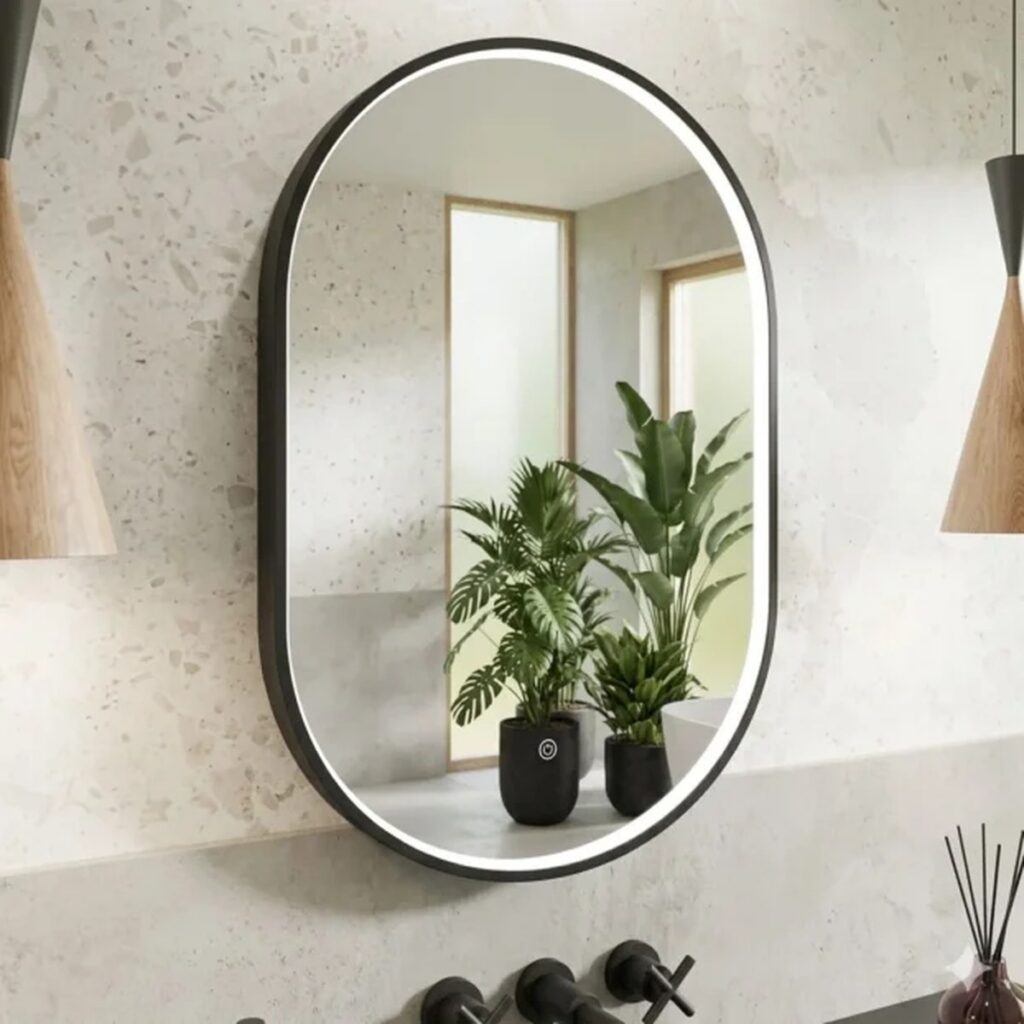
Key takeaways:
- A LED bathroom mirror with an antifog function prevents fogging and ensures a clear reflection after showering.
- Lighting should be cool white (4000-6000K) for makeup and shaving, and warm for ambiance.
- A touch switch is practical because it does not leave smudges and is easy to clean, but check if it is moisture-sensitive.
- Choose mirror dimensions based on bathroom size: at least 60 cm wide for one person, 80-100 cm for a couple.
- Installation must be safe: check that the mirror has IP44 protection for wet zones.
When choosing a LED bathroom mirror, it is not enough to just like how it looks. Practical features such as antifog, quality lighting, and an easy touch switch make the difference between a mirror you use with pleasure and one that just annoys you. In this guide, we go through the key things to pay attention to, without marketing fluff, only what you really need.
Antifog: why this is a feature you should not skip
A fogged mirror after a hot shower is one of the most common problems in the bathroom. Antifog (or anti-fog) technology solves this by heating the mirror surface and preventing condensation. When choosing a LED bathroom mirror, check whether the antifog works automatically or via a switch. Automatic is more practical: it turns on as soon as it detects moisture. Also, pay attention to the heating power: too weak will not help, and too strong can increase electricity consumption. At the Smart Home Shop brand (available at https://smarthomeshop.rs), most models have built-in antifog, but always check the specifications.
Lighting: color temperature and LED strip layout
LED mirrors come with built-in LED strips, but not all lighting is the same. For daily use (makeup, shaving), cool white light from 4000 to 6000 Kelvin is recommended: it gives the most natural look. Warm white (2700-3000K) is better for ambiance, but not for precise tasks. The layout of the LED strips is also important: it is best when the strips are on the sides or around the entire mirror, because they illuminate the face evenly without shadows. Avoid models with only one strip at the top: it will create harsh shadows under the eyes and chin.
Touch switch: how it works and what to look out for
The touch switch is standard on modern LED mirrors. It works on the principle of a capacitive sensor: you touch the surface and the mirror turns on or off. The advantages are obvious: there are no physical buttons that break or collect dirt. However, not all touch switches are the same. Check if it is moisture-sensitive (some models may react to water droplets) and if it has memory: whether it remembers the last lighting setting. Also, pay attention to whether the switch has protection against accidental activation (for example, if you touch it with a towel).
Dimensions: how to choose the right size for your bathroom
The dimensions of the mirror directly affect functionality. For one person, the minimum width is 60 cm, and for a couple or family, 80-100 cm is recommended. The height should be such that the mirror covers the entire face and upper body: usually 60-80 cm. Measure the wall space where the mirror will go, taking into account the distance from the faucet and sink. Do not forget to leave enough space for opening cabinet doors, if any. If the bathroom is small, consider a mirror with a built-in shelf or drawer: a practical solution that saves space.
Additional features and safety: IP44 and other markings
When buying a LED bathroom mirror, safety is a priority. Check if the mirror has IP44 protection: this means it is resistant to water splashes and suitable for wet rooms. Also, pay attention to the power supply: whether it plugs into a standard outlet or requires professional installation. Some mirrors have a built-in dimmer for adjusting light intensity, which is useful for creating ambiance. If you plan to use the mirror for makeup as well, look for a model with a magnifying section (2x or 3x magnification). Smart Home Shop offers several models with these options, so check their assortment.
Check the offer
Frequently asked questions
Does a LED bathroom mirror use a lot of electricity?
No. LED diodes are energy efficient: they typically use 10-30 W, which is comparable to a regular light bulb. Antifog adds another 10-20 W, but it only turns on when needed.
How do you clean a LED mirror with a touch switch?
Use a soft cloth and a mild detergent. Avoid abrasive cleaners and too much water on the switch. Most models have moisture protection, but it is better not to spray too much.
Can I install a LED mirror myself?
Most models come with templates and screws for easy installation. If you are not sure about the electrical connection, hire an electrician. Check that the wall is strong enough to support the weight.
What is the difference between an antifog and a regular mirror?
An antifog mirror has a built-in heater that warms the surface and prevents condensation. A regular mirror fogs up and you have to wipe it. Antifog is more expensive, but more practical for daily use.
Can a LED mirror be used in a small bathroom?
Yes. There are models 40-50 cm wide that are ideal for small bathrooms. Choose a mirror with a light frame and cool light: it will visually expand the space.